Combat rating 10
1 Fomorian (CR 8)
1 Wererat 2 (CR 2)
2 Quaggoths (CR 2)
1 Quaggoth thonot(CR 3)
Combat rating 11
1 Fomorian (CR 8)
2 Carrion Crawlers (CR 3)
1 Manticore (CR 3)
1 Black pudding (CR 4)
Combat rating 14
1 Fomorian (CR 8)
1 Vrock (CR 5)
2 Kuo-toa monitors (CR 3)
1 Oni (CR 6)
1 Shambling mound (CR 5)
Combat rating 16
1 Fomorian (CR 8)
1 Violet fungus necrohulk (CR 7)
1 Grick ancient (CR 7)
1 Otyugh (CR 5)
2 Trolls (CR 5)
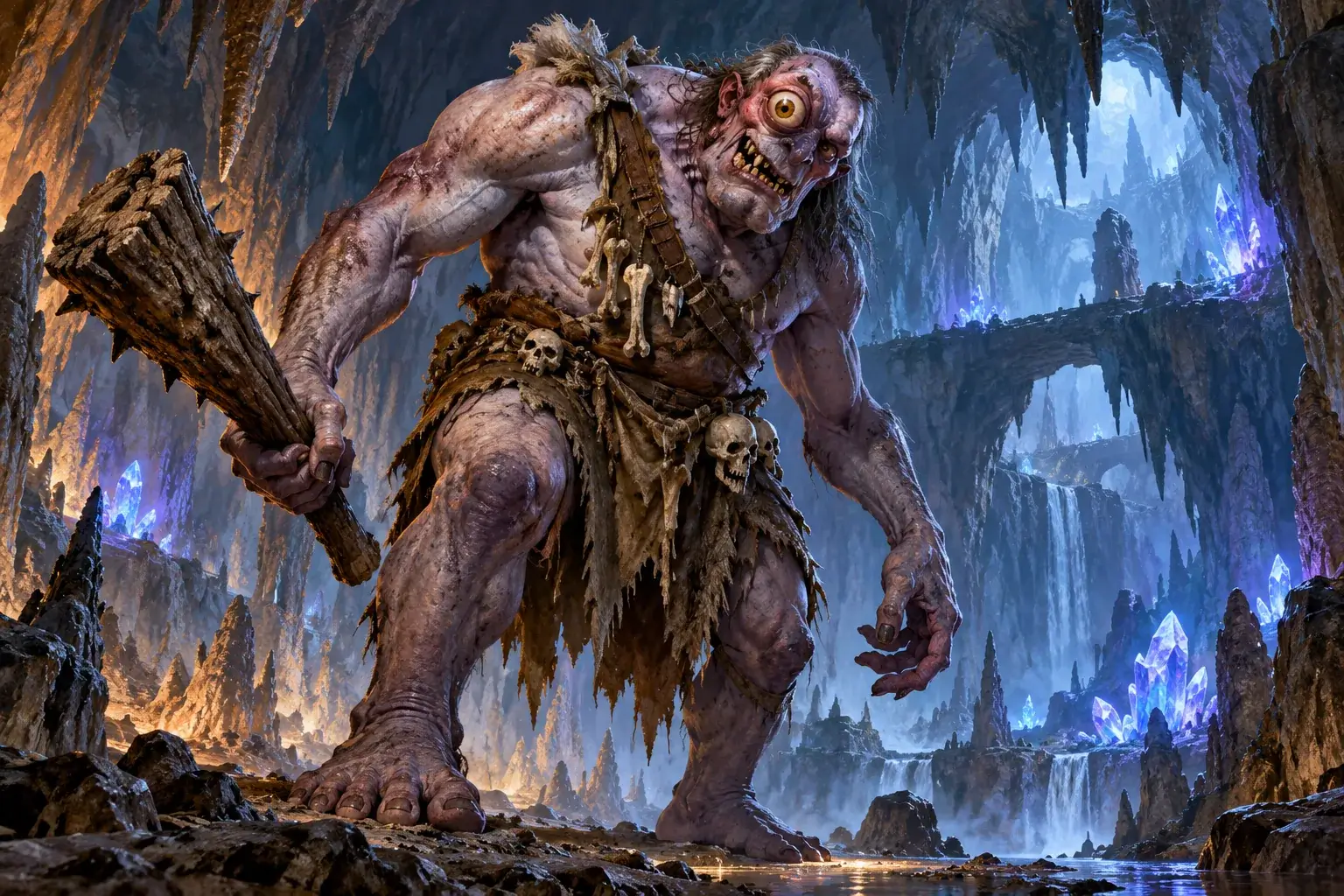
Fomorians are evil giants [extra evil giants, I guess. It’s not like most giants are good.] So evil that they were kicked out of the giant caste system, banished underground, and permanently disfigured. But everything has a silver lining, and the fomorians found a way to project their ugliness onto others, giving them a neat weapon.
How to Use a Sadist Overlord
Fomorians are among those who think that beating their slaves until they can barely stand will somehow make them work better. As such, one sign that you’re approaching a fomorian’s territory is encountering disfigured monsters of various types that are much easier to defeat than they should be.
On Exhaustion and CR
While I can’t give an absolute rule for how exhaustion affects CR, my best estimate is that, for a monster relying exclusively on attack rolls, each level of exhaustion effectively reduces its CR by one.
If a significant part of the monster’s offense relies on forcing saving throws, the reduction will be much smaller, since exhaustion doesn’t affect the DCs of those saves. For a monster whose offense is split evenly between attack rolls and saving throws, I’d estimate half the reduction given above. Adjust this based on the relative importance of each type of attack, including the strength of their effects, not just how frequently they’re used.
If the party frequently forces enemies to make saving throws, the fight will be even easier.
These estimates use the 2024 exhaustion rules. Under the 2014 rules, the first two exhaustion levels have relatively little effect on most monsters. The third level, which imposes disadvantage on attack rolls and saving throws, is much more significant.
How to Use Weakened Monsters
There are three types of encounters that can build around this, although only the first two really work.
Normal Monsters Made Easy
The players encounter 1–2 monsters, ideally of types they’ve already fought, but now disfigured.
The fight will be fairly easy, although you can make it harder with surprise, terrain that favors the monsters, or a distraction such as a magical effect or the need to rescue an NPC ally. The main purpose of this fight is to introduce the fomorian, not to challenge the players.
Normal Monsters in Bulk
The players encounter a group of monsters of a type that would normally provide a reasonable challenge, but are now weakened by the fomorian’s curse. This is offset by their sheer numbers.
One possibility is for the players to spot a cavern full of these monsters ahead of them. They’ll have to figure out how to defeat them or sneak past.
Alternatively, the monsters can take the players by surprise, forcing them to find a way to survive. Either way, finding terrain that favors the players will be crucial. Examples include a high position to shoot from or a narrow alley serving as a chokepoint. Think carefully about the battlefield when designing the encounter, and avoid monsters that restrict movement.
Not Recommended: A Powerful Wounded Monster
I would recommend against is using a monster that’s normally too powerful for the players to defeat. Books and movies can make this work because their authors control every aspect of the story. In D&D, however, there’s a good chance the players will either get lucky, making the encounter underwhelming, or get unlucky and be slaughtered. Avoid it.
Combat Encounter 1: Death Tag (Difficulty 10)
The fomorian is extremely well suited to fighting the players from a distance, using its Evil Eye.
- Evil Eye and Darkvision: Evil Eye’s recharge means that it will only be available occasionally, but the fomorian’s 120 feet of darkvision means that it can see the PCs long before they can see it.
- Speed: Its 40-foot movement speed, combined with the ability to Dash between attacks, makes staying out of the players’ reach relatively easy.
- Splitting Up: Catching the fomorian requires splitting up, but splitting up is dangerous. One of the PCs might manage to reach it, but no single PC is likely to defeat it alone.
Setting the Scene
For this encounter to work, it has to look right. You don’t want the big, powerful, nasty giant to appear afraid of the PCs. Instead, have it mock them, ridicule their inability to stop it, belittle their accomplishments, and laugh off anything they say to bait it into coming closer.
(While this is annoying, it also makes the eventual victory sweeter, so it all cancels out.)
You probably don’t want an endlessly large cavern, since the fomorian could simply attack and retreat, leaving the players with no realistic way to catch it. I’d suggest a cavern about 120 × 80 feet (24 × 16 squares), with a handful of stalactite/stalagmite pillars where the formations have joined from floor to ceiling.
These will add some detail to break up the monotony without fundamentally changing the encounter. Your players might also find ways to use them, such as hiding behind them.
Running the Fight
This brings us to the combat itself. If the players stick together, the fomorian will dance circles around them, gradually wearing them down. While relying on evil eye will mean skipping attacking on some turns, if it only prevents the Fomorian from getting attacked, it can come out worthwhile.
If they split up to corner it, one of them might manage to reach it, but that PC will probably take more damage than they can deal.
Which PCs the fomorian targets is up to you. It has enough Wisdom to make a reasonable guess about their classes, but that doesn’t necessarily mean it will care. One thing I’d suggest is that anyone who manages to annoy it should become a priority target. What annoys the fomorian is up to you. Also, if a light spell or something similar interferes with its tactics, it will know who cast it.
Additional Tactics
When one of the players eventually catches up to the fomorian, remember that it can simply walk away. Most players are reluctant to provoke opportunity attacks, but taking a single hit is often a small price to pay for escaping melee range.
It might be worth having the fomorian circle around the players and block the entrance. Otherwise, there’s a good chance they’ll retreat, and the fight won’t be as difficult the second time around. Blocking their escape will also make the encounter much more frightening if they start losing.
If you want, you could add obstacles that force the players to make climbing checks but which the fomorian can simply step over. In my opinion, the fight is difficult enough without them. However, they might be worth adding if the players retreat and return for another attempt.

Combat Encounter 2: Rock Climbing Made Hard (Difficulty 11)
While most people treat the Underdark as a dungeon, with tunnels, doors, and rooms, it’s actually described as more of a giant cave system. Among other things, this means that not every passage is a horizontal tunnel. Sometimes, you’ll have to squeeze through cracks. Other times, the passage will be vertical, and you’ll need to climb.
Using this sort of terrain adds an interesting new element to your game. It also introduces new challenges. For our purposes, the challenge of the players being busy climbing down a cavern wall when they’re caught off guard by a cruel fomorian.
The fomorian’s enormous size means that it can reach the PCs while they’re still many feet above the floor. Its reach allows it to attack them in melee, while they can only retaliate with ranged attacks.
(They do have the option of jumping onto its body. Run that as you will. I’d start with a DEX (Acrobatics) check, followed by saves against being dislodged.)
Setting the Scene
You might want to put spikes or sharp rocks at the bottom of the wall, since falling damage in D&D is relatively low, and simply dropping down might otherwise be advantageous.
An even stronger idea is to have water covering thick mud, with a few outcroppings that provide a safe route across. If the players climb down properly, they can cross using the outcroppings. If they jump or fall, they’ll become stuck in the mud.
Falling Rocks and Collapsing Ledges
In addition to dealing damage, the fomorian’s attacks can cause any of the following effects:
- A Ledge Is Destroyed: The players must find another way down or make a DEX check to maintain their footing. You can decide which consequence applies or offer the players a choice. This is especially nasty when it leaves party members separated from one another.
- Falling Rocks: The fomorian’s blow dislodges large rocks, sending them crashing down toward the players. Simply dealing damage is boring. Instead, consider the following possibilities:
- Pinned: A PC is knocked prone and pinned beneath a rock. Freeing themselves requires a successful STR check (not necessarily an easy one). Alternatively, another PC can reach them and spend an action lifting the rock, possibly with an easier STR check.
- Blocked or Damaged Ledge: Falling rubble blocks a ledge or damages it. Unlike a destroyed ledge, a blocked one can be cleared with STR or climbed over with DEX. A damaged ledge might collapse later.
- Knocked Off: A PC is knocked off the ledge. Even better, they’re left hanging by their hands and need to be pulled back up by a friend (probably a bonus action). The players will probably insist that a DEX save or check should allow the dangling character to recover independently.
- Imminent Collapse: A ledge is weakened but doesn’t collapse. Yet. Choose one of the effects above and apply a weaker version as the ledge partially gives way. Make it clear that a full collapse is imminent, giving the players good reason to avoid standing beneath it.
- The Club Gets Stuck: The fomorian’s club becomes lodged in the wall, either accidentally or deliberately. On the one hand, this creates an opportunity for melee PCs to attack it, perhaps even climbing along the club and onto its body. On the other hand, when the fomorian pulls the club free on its next turn, rocks will come crashing down, and the nearby ledge will collapse.
Additional Tactics
The fomorian will, of course, use its Evil Eye whenever possible, making the climb even more difficult.
If you really want to be nasty, have it grapple a PC once or twice instead of attacking, then move its captive onto a ledge on another wall. It might even place them behind a pillar, where they can’t see the rest of the party.
The route down from these new positions, and the consequences of falling or jumping, might be even worse.
More Underdark and other terrain hazards. See especially Behir
Summary: Six Ways to Use
- The fomorian’s territory is marked by disfigured monsters, victims of its Evil Eye. Start by letting the players encounter an individual deformed monster. Later, corner them with a large number of these weakened creatures, forcing them to find a way to escape.
- The fomorian can fight effectively without letting the players see it, using its Evil Eye whenever available and hit-and-run tactics in between. Add darkness, and the players may have to split up just to find it. But how can they defeat it while separated?
- Have the fomorian wait on the opposite side of a river. The players must figure out how to cross while its Evil Eye makes the journey incredibly difficult. Once some of them reach the other side, they’ll have to hope they’re strong enough to fight it.
- Underdark travel can require climbing as well as walking. Have the fomorian come upon the players while they’re still descending a cavern wall. Its enormous size allows it to strike them while they’re still clinging to the rock.
- The players approach the fomorian and encounter one of its tortured monster slaves. Suddenly, a boulder seals the entrance behind them. They’ve entered the fomorian’s arena, and must survive and find a way out while it weakens them with its Evil Eye.
- While fomorians can’t throw boulders, they can knock rocks down onto the PCs. The players must make DEX saves to avoid being buried, while the falling rocks reshape the battlefield. The fomorian might even cause the floor to collapse, sending them plunging into the depths.

Leave a Reply