Combat rating 1
1 Gas Spore Fungus (CR 1/2)
3 Kobold Warriors (CR 1/8)
Combat rating 1
1 Gas Spore Fungus (CR 1/2)
5 Stirges (CR 1/8)
Combat rating 2
1 Gas Spore Fungus (CR 1/2)
2 Darkmantles (CR 1/2)
3 Flumphs (CR 1/8)
Combat rating 3
1 Gas Spore Fungus (CR 1/2)
4 Piercers (CR 1/2)
3 Rust monsters (CR 1/2)
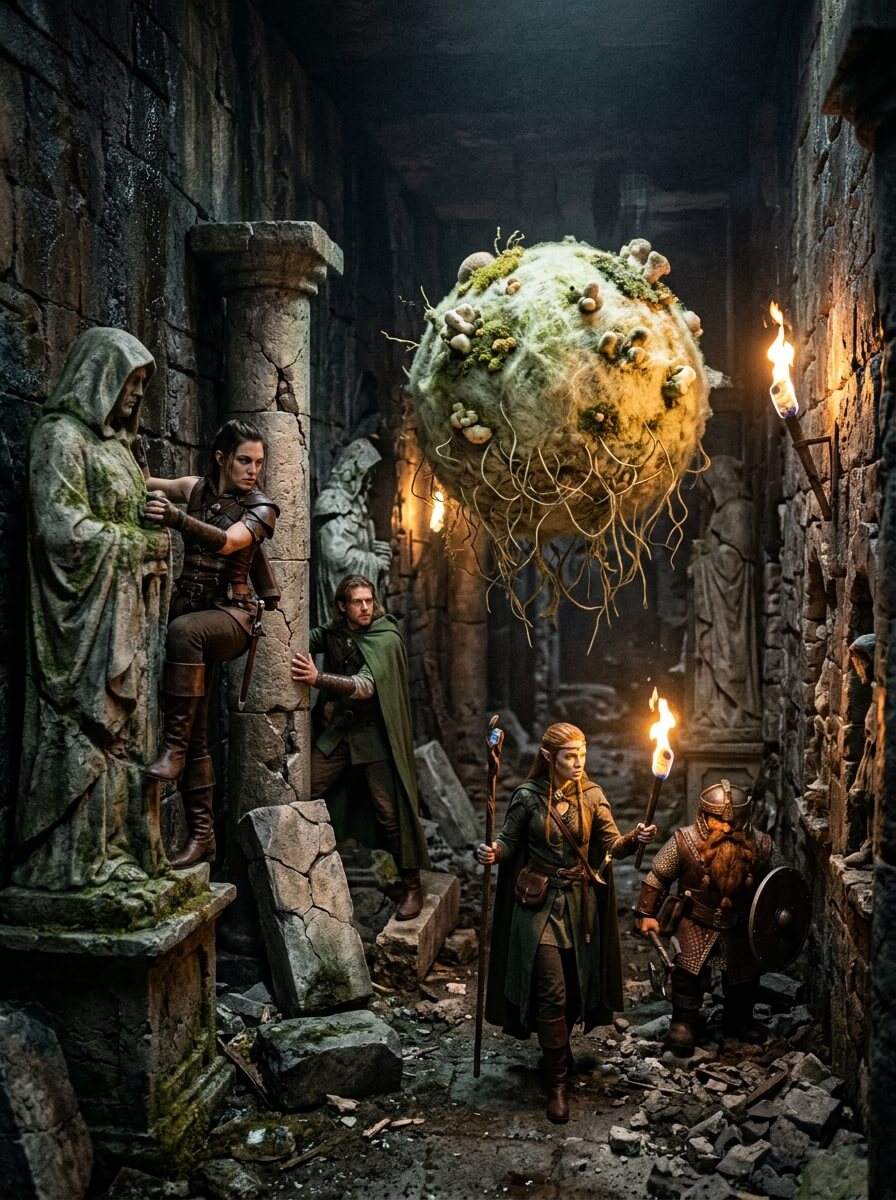
The gas spore is a floating ball of fuzzy moss that has just enough sentience to deliberately attack people.
Actually, figuring out why it would attack—or do anything—is pretty difficult. It reproduces when it dies, not when it attacks (at least, not since the 2024 Monster Manual came out). It shouldn’t have wants or dislikes, and even if it did, it wouldn’t have the intelligence to act on them.
We’re left with choosing between three options:
- The gas spore knows on a subconscious level that attacking is the best way to get destroyed, and thereby reproduce.
- When it’s destroyed, it can also take root in nearby corpses, so racking up a kill count increases its numbers.
- When it kills someone, the fungus can take root and start growing in the dead bodies of its kills.
The first is RAW, and the last is the most logical. The second is somewhere in between. None of the options should affect gameplay. Choose your poison.
Gas Spore “Tactics”
As mentioned, the gas spore seems like it should be a completely oblivious ball of fuzz, except that it apparently can be bothered to attack people. When deciding how it will behave, I see three ways to run it. Which one you choose will greatly affect how you use gas spores.
Aggressive: The gas spore moves toward the nearest target and attacks. I would personally rule that the gas spore will only move toward a target that has entered its 30-foot radius, but that if the target entered that radius since the gas spore’s last turn, it will still pursue in that direction. After all, turns are supposed to be an abstraction of events happening simultaneously.
Passive aggressive: The gas spore mostly ignores people unless they have some particular trait, such as a certain smell, that the gas spore takes offense to. The game will mostly consist of trying to guess what the gas spore is reacting to. I’ll give ideas in the combat encounters below.
Mostly passive: The gas spore ignores the players unless they do something that deliberately provokes it, such as grappling it.
This article will be about the first type, aggressive spores. My next article will present encounters built around the passive agressive and mostly passive archtypes.
(If you use more than one type, make the spores different colors, and consider telling your players straight out that the different colors have different rules. Your players need to know this.)
Combat Encounter 1: No Room to Hide (difficulty 2)
The gas spore is in a narrow area. In order to get the object or whatever else the players are after, they’re going to have to have one of them lead it out of the way.
As mentioned, the area has to be fairly narrow in order to make this challenging. At the same time, there has to be enough room to let them maneuver. Finally, there has to be some reason they can’t just lead the gas spore all the way back to wherever there was room.
(Even if it would mean hours of backtracking, that won’t stop them. It isn’t your players’ time and energy, it’s their characters’. Hours of backtracking only take a moment to narrate, so why not?)
Ways to prevent backtracking include:
- Any type of one-way effect, such as a portcullis that comes down behind them when they move on to the next room. Perfect for dungeon runs, not so good for open playgrounds.
- Any narrative reason to prevent backtracking. If they entered without the villains knowing, they can’t just leave or they’ll be detected. Similarly, a magical reason that the area is only accessible at certain, infrequent times.
- Any area that does some damage, even minor, when they pass through. Typically, this is because the area contains minor, unintelligent monsters. As a plus, not only will the players be unwilling to backtrack because it would cause them to take damage, but they might not even be able to, as the monsters will attack and trigger the gas spore.
- Instead of preventing backtracking, make it useless. For example, rule that a curtain of water is an obstacle the gas spore won’t pass through, and place a waterfall over the cave entrance. If the players lead the spore back to the waterfall and run through it, the spore will simply drift back toward the objective, forcing them to try again.
Making Movement Difficult
The rest of the scenario has two main parts. You want just enough room that the players can evade the spore with difficulty, and you want minor traps or obstacles so that the players darting past also have something to do. You don’t want enemies, as fighting them will take up an unfair amount of game time and focus, which could lead to bad feelings.
Statues Lining the Avenue: This makes a great example. Have a path that’s only wide enough to allow single-file movement, with statues on either side that can be climbed onto. If the PCs have enough DEX, they can even jump from one to another.
You can, of course, make some of the statues trapped as well, with some shooting fire or spikes at people who step in front of them. Detection can involve skill checks, figuring out the pattern from the remains of previous activations near the first couple of statues, or you can just make the traps obvious. Getting past them is challenge enough.
Alternate Obstacles: You can use any type of trapped obstacle you like. All you need to do is figure out what type of decorative features fit your dungeon. Ideas that change the scenario up a bit include:
- Fountains: The players can go to the sides, but the fountains have slippery floors that slow them down, while the gas spore can fly. Since fountains often have statues next to them, you can have the statues attack only people inside the fountains, or send out a jet of water when triggered that knocks PCs down.
- Poorly Stacked Piles: Any type of objects, whether boulders or boxes, that are in loose piles. The players can climb onto them, but causing them to fall will not only knock the responsible PC down, but also block the way. A skill check (Investigation or Perception) will let the players identify the most dangerous areas.
- Any Type of Trap: The players will have to go off the beaten path to avoid the gas spores, but that area has trapdoors, swinging blades, or something similar. To make this more natural, have the players know the safe route thanks to a map they acquired, rather than having it simply be a straight path down the middle.
Alternate Goal: All the players have to reach the other side. They aren’t after an item, but rather passage through. One solution is to pull the gas spore back and forth, with the final player needing a lot of DEX to jump from statue to statue, assuming the party don’t find a magical solution.
Combat Encounter 2: The Shifting Floors (difficulty 3)
The gas spore works nicely in a room where the floor is trapped and needs to be walked on in a certain order (examples below).
Without the gas spore, the entire challenge is to figure out a route. With 1–2 gas spores, navigating it becomes a headache and a half.
To make this challenging, even with the gas spore, you’ll want to do one of two things:
- Non-repeatable tiles: Each tile can only be stepped on once. In addition, there is some rule as to which tiles can be stepped on. Since all the players need to get through, they’ll need multiple routes. For example, you could have a layout of different colors, with the players needing to step on tiles that match the color of the light in the room that turn.
Recommended size: 15 feet of width per PC, with one gas spore for every two PCs, rounded up.
- Coordinating tiles: The tile that one player steps on affects which tile another player needs to step on. For example, the tiles have different numbers, and the players need the numbers on the tiles they’re stepping on to add up to a number between 20 and 40.
Recommended size: 20–25 feet of width per PC, with one gas spore for every three PCs, rounded up.
In both cases, the size depends largely on how difficult the puzzle is and how many options the players have. The fewer tiles they can step on, the wider the room has to be so that they have room to move.
For length, a short encounter would use a room 60 feet long. This is good for a quick encounter to break up scenes. A longer encounter would use a room 100–150 feet long, probably with an additional 1–2 batches of gas spores farther into the room, so that the players can’t make it simple by outdistancing the original spores.
Combat Encounter 3: Warehouse Shelves (difficulty 3)
A warehouse lined with shelves is another area where dodging gas spores can make navigation tricky. This idea works well with traps or can be used as a puzzle.
Description: The room is a long area lined with shelves containing mundane or magical items, as you see fit. Add 1–3 rows of shelves down the middle. Shelves can be climbed over or crawled through. (As this is easier than navigating the statues in the previous encounter, it also gives you the freedom to have 2–3 gas spores.)
Traps: The players can be tasked with finding certain items, but removing things from shelves triggers traps that fit the shelves’ themes.
Puzzle Challenge: Warehouse shelves also give you a great puzzle opportunity if you make the players figure out the arrangement in order to locate the items on their shopping list. The gas spores add pressure to what would otherwise be a relatively simple puzzle. Two ideas:
- Alphabetical, but by the last letter of each word: Cloth is found under H, and paper under R. I suggest one item type for each letter to keep it from getting too complicated.
- Cross-grid it: Make three or four rows of shelves, with each row representing something (animal, vegetable, mineral, say). The farther down the row you go, the more the items change based on a different criterion (above or below ground, say). The trick is that the shelving is organized along two different axes.
With both ideas, you’ll have to create a list of items beforehand so that the players can figure out the arrangement. ChatGPT can easily give you an organized list of possible items. Just make sure to specify a low-tech era and any other requirements you might have.
Variants for Extra Difficulty: When something is removed from a shelf, the shelf turns 90 degrees, changing the area’s layout. (They also shift somewhat, so that there is either a passage or a dead end, not a narrow crack that can be squeezed through.) To stop players from abusing this, I suggest a few points of damage each time something is removed.
If you want to be really nasty, the nature of what’s on the shelves changes, either for a time or until the players take something again (in which case you still need the damage).
If you really like to infuriate your players, at least one of the items they need will only be available after they change the shelves’ contents. In that case, you need a rule for what the items change into. (Items naturally appearing in light colors could change into ones appearing in dark colors, say.)
Make sure you have sufficient ideas for each category of shelves before starting.
For more articles using Traps and Puzzle

Combat Encounter 4: Climb to the Top (difficulty 3)
The players need to reach the top of a tall room. What they have is a lot of rope and the ability to lasso parts of the wall where a brick or decorative feature is sticking out, allowing them to build their way up. Unfortunately for them, there is at least one gas spore hovering in the middle, halfway to the ceiling, and they’ll have to be careful if they want to get past it.
You might want to give them magic ropes that can connect to one another in order to help the players realize what they need to do. I might also give the ropes an ability to make feet stick to them, so that even the non-DEX PCs can walk along them without a problem.
Ideally, have a friendly NPC give them these earlier on, as it looks strange to have the magic ropes needed to pass an obstacle lying right outside that obstacle.
To design the scenario, create a number of maps with numbers next to them, representing the heights of the different levels. Each level will have an almost identical layout, the only difference being the number of place of the protrusions. Decide whether the players can advance two levels at a time or only one.
If you’re using the magic ropes mentioned above, you might want to make advancing one level succeed automatically, while advancing two levels requires a skill check. Dashing should probably require a skill check, as should jumping from one rope to another.
The reason for the skill checks is to make the effects of being Poisoned matter.
For another climbing scenario, see Silver Dragon Wyrmling
Combat Encounter 5: The Empty Halls (difficulty 1)
The players come upon a series of rooms that are empty of life, except for multiple gas spores. They have to split up, with some of the players luring gas spores away while others go for the objectives.
Design the area with rooms that connect to one another in multiple ways. It shouldn’t look like a line of rooms, but rather a 3×3 grid, or something similar. (You might want to dress it up a bit, with a room that’s longer and occupies the space of 1.5–2 rooms, and similar variations.)
You need the rooms to be large enough to maneuver around in, but not so large as to make eluding the gas spores easy. I suggest placing a number of obstacles that can be climbed over, such as statues, fountains, tall plants, shelving, etc.
Climbing will use up more movement than traveling over open ground, and might require actions and/or DEX/STR checks. I suggest allowing checks to reduce the movement cost or avoid the need to use an action.
This scenario works nicely with a treasure hunt format. To complete their mission, the players need to reach the first objective, which will give them a clue leading to the next objective. Use 3–5 objectives, all in the same area, and keep the clues fairly easy to solve so as to keep the game moving.
Combat Encounter 6: DodgeSpore (difficulty varies)
The players face a group of foes whom they have to fight while both sides try to avoid the gas spores and get them to pursue the other side.
Recommended Enemy Choice: You want about 2–3 enemies, ones that lean toward melee but ideally have some ranged attacks. Having the ability to knock PCs prone is a nice bonus, but you don’t want grappling or stunning abilities.
Make sure to start with the gas spores closer to the PCs than to the enemies. If not, they can cripple the enemy with a single death burst.
The Logic: When one side outnumbers the other, the smaller side tends to stay still to avoid taking too many opportunity attacks. You want a battle where both sides move around. (People will take opportunity attacks in this battle, as remaining still is even worse. What I’m avoiding is a single enemy taking opportunity attacks from everyone each round.)
Having melee units in the fight tends to encourage movement.
Use no more than 1–2 gas spores to make movement possible.
Terrain: You want it fairly open. You can put some large obstacles that both sides might circle around, but you don’t want dead ends. In the same vein, you could put a patch of difficult terrain, but not too much. Both sides need freedom of movement.
Note: When setting up this encounter, realize that you’ve made area-of-effect spells much harder to use than their normal. If your players use them a lot, keep this in mind when determining encounter difficulty.

Leave a Reply