Combat rating 1
1 Faerie dragon youth (CR 1)
2 Pseudodragons (CR 1/4)
Combat rating 2
1 Faerie dragon youth (CR 1)
5 Pixies (CR 1/4)
Combat rating 3
1 Faerie dragon youth (CR 1)
3 Performers (CR 1/2)
1 Black bear (CR 1/2)
Combat rating 3
1 Faerie dragon youth (CR 1)
1 Cockatrice (CR 1/2)
4 Flumphs (CR 1/8)
3 Myconid adults (CR 1/2)
[/spoiler]
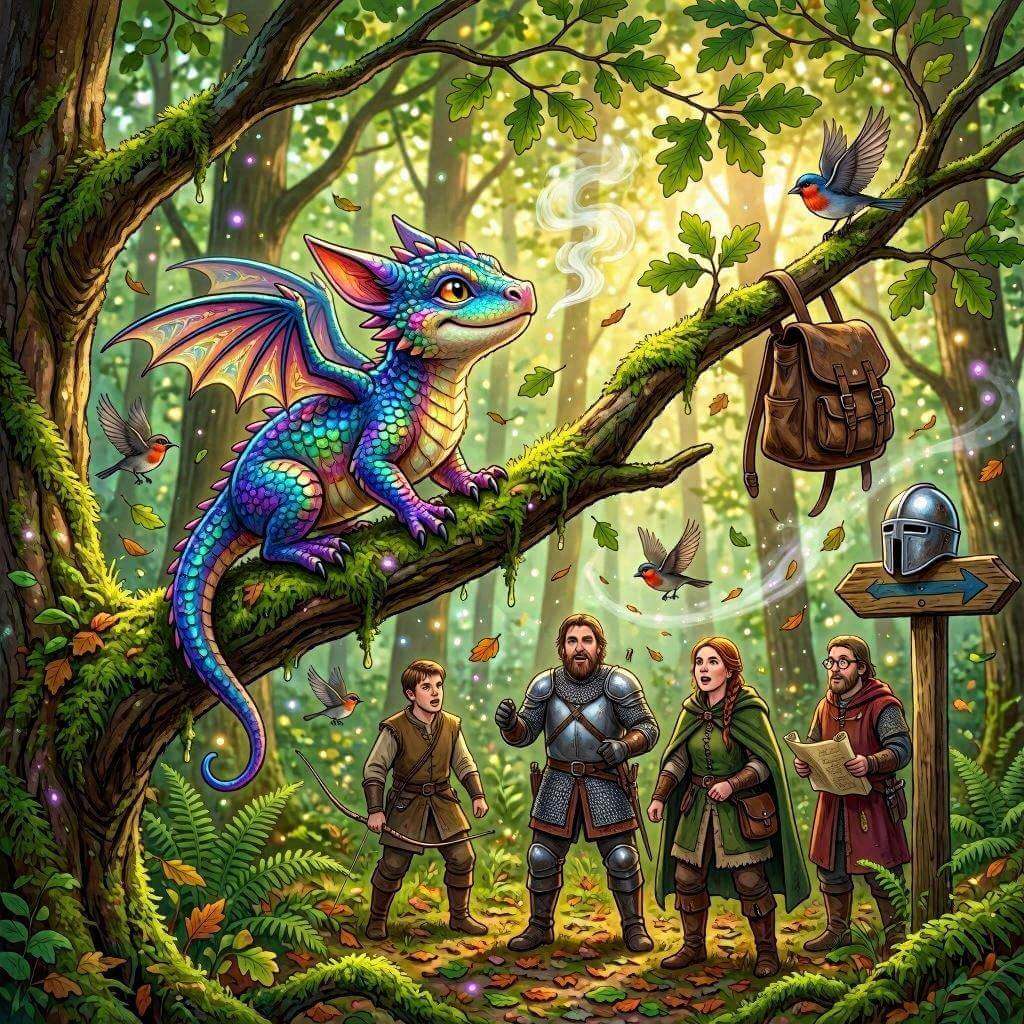
The faerie dragon is a small, colorful dragon that loves playing tricks, but is mostly friendly.
In the 2014 Monster Manual, he would change color as he grew older, learning one new spell for each age. The 2024 edition simplified it and removed Mirror Image and Greater Image from his list of spells.
His spells and abilities are invisibility, illusion, and the ability to send people wandering helplessly in a random direction. Frankly, this is a monster that is a lot more dangerous than his CR 1–2 suggests, and is only rated that low because of his harmless demeanor and because he can be knocked out very quickly, if he can be spotted.
How to Use Practical Jokes in D&D
The faerie dragon’s suggested use is as a practical joker. This is not something that is easy to do in a TTRPG. One website that I saw suggested putting sand in PCs’ shoes and other things of the sort (which I couldn’t even be bothered to remember) and seeing if they’d blame each other.
It should be fairly obvious that this won’t work. In the first place, without actual inconvenience, the joke will be ignored. Your players won’t even bother responding to it. In the second, when no one gets angry, no one bothers to accuse the other, and no one has trouble believing a protest of innocence. Nor is it plausible that they’d do it in the first place.
In order for a practical joke to work in D&D, you need the two elements that you need in any interaction worth mentioning:
- Choice.
- Consequence.
I’ll suggest a few practical jokes that should work below, but first three general rules to keep in mind.
1. Let the Players Know Who Is Responsible
A practical joke works best when the culprit can be identified. Being tricked into thinking that it’s something else is part of the joke.
If you’ve already introduced the faerie dragon, then you’re golden. Just try to have the new joke happen in the same general area, or give a reason why the faerie dragon traveled here.
If the faerie dragon is being introduced for the first time, let the villagers tell the adventurers of the mostly harmless problems they’ve been encountering. Doors jammed shut, a hen found sitting on all the eggs in the chicken coop, or whatever fits.
2. Keep the Players Engaged
If your players are like mine, they have a strong preference for combat and action. Getting them involved in social interactions can be frustrating, especially if they don’t have a strong motivation—generally curiosity—to be engaged, doubly so if they feel that the interaction is a waste of their time. Practical jokes are a waste of time by definition.
What you can do to make it better is to have a combat toward the beginning of each session, when practical. This sates their appetite and leaves them more open to other parts of D&D.
You do need to be able to make the combat short enough to leave time for other things, and interesting enough to give them what they want.
If your players’ favorite activity is something else, apply this advice toward that. If your players like everything, then you have great players. Enjoy.
3. Don’t Decide the Ending
Running the faerie dragon works best when you don’t think too much about how you want the encounter to go. Come up with a handful of complications you can throw in if the game starts to bog down, and then play it by ear. Be open to ideas that you never would have thought of beforehand, and don’t stress too much about the outcome.
(A general rule I keep stressing: If the DM plans for the encounter to lead to a certain result, and he doesn’t plan for the possibility that the result won’t happen, he will end up forcing the game toward that result, leaving no room for player innovation or challenging scenarios. After all, what challenge is possible when victory is predetermined?)
Practical Jokes of the Wild
- A noise in the area causes the PCs to investigate and fall into a pit. This is best when the PCs are in a hurry or are trying to get away from something.
- A variant: The PCs hear growling and are drawn into a cave system to investigate. If growls don’t work, escalate to cries for help. After being led around by the nose for a while, the players discover that something dangerous is now outside the cave. I suggest something that they can’t just fight.
- In a reverse of the previous, the rustling of bushes and such gets them to hide from a non-existent monster. This requires setting up a legend and having the players be low on HP and resources. (If the players aren’t in a hurry, I suggest that the supposed monster is only active at specific times, to stop them from immediately investigating.)
- They come to a bridge across a river they need to cross. The faerie dragon shows itself and does everything it can to persuade them to cross the bridge. Be serious enough about it, and they’ll go to incredible lengths to get across without the bridge. (Add water monsters, or a strong current.) There isn’t anything wrong with the bridge, or course.
- The faerie dragon, acting as a forest spirit, sends them on a bogus quest after a fake reward. (This is easier if he first sends them on a minor, completely real quest with a reward to build credibility. This can be a bush with special berries guarded by something right nearby.) He might also make noises to help lead them on until they’re lost, and then disappear, in the best traditions of the snipe hunt. When they come back, they find that their starting location was damaged or destroyed. (This can be literal, or it can be that they were framed and are no longer welcome.)
While several of these jokes lead into disaster, it should be noted that the faerie dragon didn’t mean for these disasters to happen.
Once he sees that what he did led to real trouble, he’ll probably do what he can to aid the players. His ideas of help are pranks like leading monsters astray with noises, and he rarely coordinates with the players or follows instructions if he thinks he has a more fun way. Eventually, the players will have to decide if they want such help.
(In my next article, I’ll discuss ideas for pranks using the adult faerie dragon’s spells. They give some interesting options.)
Urban Jokes
Dirty Pool
If the players need to meet with an important NPC for some reason, warn them that the NPC puts stock in appearance, and that they’ll take dice roll penalties if they aren’t clean.
I suggest giving them a warning when they arrive at the location, forcing them to find an excuse to push off the meeting until the next day, maybe making them spend a few silver on clean clothing, and then putting them through a gauntlet targeting their clothes one by one. (I chose silver as the coin spent on clothing so that they don’t resent it. If your players are like mine, they ignore anything less than gold.)
For a discussion as to how to use both dice rolls (skill checks) and roleplaying, see the second part of my negotiations page.
I’ll add that any time the DM creates a non-combat encounter, he should plan around the possibility of failure, or else he’ll feel forced to let them succeed.
Ideas:
- A bucket of slime over a door in the inn, with a strange noise calling them in.
- Horses spooked into galloping through a ditch of water and splashing them, right after they figured out how to cross it safely.
- A sack of flour or sand getting split open, with the wind blowing it toward them. Don’t make them dirty immediately, as that is unfair, but have it block the area and make it hard to leave the area without getting dirty. (Narrow alleys nearby, a ditch behind them, hanging laundry, etc.)
- The faerie dragon bribes or convinces a group of children to advance on them with muddy hands. (If they bribe the children, the children try to demand more payments, or the faerie dragon brings in every child in the city. [“These guys are giving away free gold!”])
- A stall of pigs is released and fills the street in front of them. The farmer is trying to get them back, and will be furious if the players fireball them.
- Minor illusion can create piles of garbage and the like blocking stairs and the like. Eventually, they’ll have to figure out which is real, and walking through one might stop them from seeing the tripwire or greased floor behind it.
Attention Distracter & Disorder
The NPC they want to talk to keeps getting distracted by disturbances happening around him. Their presence at said party is without permission, forcing them to avoid drawing too much attention if they don’t want to be thrown out.
This works best at a busy location, like a party, and with the players having multiple goals, such as multiple NPCs to talk to, a quest item that they need to steal (or the keys to said item), a danger that they’ve been warned about and will need to remove, or a combination of at most two.
You need the distraction to give the players something else to do, whether it’s moving on to the next goal, dealing with the distraction, or evading notice.
Eventually, they’ll catch on to the fact that what they’re doing isn’t working. Hopefully, they’ll figure out a way to adapt.
To make this work best, they should know about the faerie dragon, and you should allow for the possibility of failure if they attract too much notice. I said this before, but it’s especially relevant to this one.
(Failure will probably happen when it accumulates over multiple mistakes, not from a single error, unless they’re really stupid or obvious and you’re left with no choice.)
An Unwelcomed Advance
An NPC finds that the door to their room in an inn is jammed, or that their satchel has been left dangling from a rooftop. About to request help, they suddenly change their mind and start making excuses to avoid help. If the players help anyway, they discover something illegal inside the room or satchel.
While not against the players, this is a great way to give them a lead to a new location. Just make sure that they aren’t wandering around waiting for you to give them a lead, or it will feel lame. They should have something else they’re also pursuing.
If you want to use this against the players, have it be an NPC friend or ally who begs them for help, to avoid being discovered.
Breaking Entrance
The players hear a cry for help. Breaking into the room leads them to catch an NPC they know in an embarrassing situation, such as changing clothes. They have to try to excuse themselves.
(The cry for help was next to the window shutter. The NPC assumed it was someone outside.)
Dark Guidance
They either overhear someone replying (or rather, they think they do), or they are called to from a dark ally without seeing the speaker. Either way, they find out about a location. Whatever will be there should be interesting, and completely different from what they were led to expect.
Like with the wilderness jokes, the faerie dragon won’t intend to do them serious harm (unless he thinks they’re evil, that is). If he does, he’ll try to help them.
By causing more chaos, of course.
For ideas of how to use humor with a more powerful enemy, see my article on the Copper Dragon.
More ways to use monsters in non-combat scenarios.
Or, check out how to use Hallucinatory Terrain and Polymorph to make even grander jokes in my very next article, Faerie Dragon Adult.

Combat Encounter: Mischief in the Woods (Difficulty 4)
When building a faerie dragon encounter, you don’t want to build it around fighting and killing the faerie dragon. Apart from its alignment, the fight is also not well balanced.
The faerie dragon will spend the entire battle hassling the PCs while invisible, and if they win, it will be by getting in a single lucky blow, which will end the fight in one punch. A good game is made out of steadily advancing until they achieve victory.
What this leaves is either giving them a different enemy which they have to defeat while the faerie dragon is hassling them, or giving them an objective and a time limit.
Since protecting themselves against the faerie dragon means not staying near one another, I suggest either a number of small animals that the faerie dragon lured toward the heroes (or vice versa), or that the players are trying to gather as many magical mushrooms or similar objects as possible before some magical effect causes the remainder to disappear.
Create a battlemap with a number of obstacles for PCs hit by euphoria breath to wander into. I suggest obstacles with effects that are inconveniencing but not too unpleasant, so that the players can be affected by them multiple times.
I’m giving multiple ideas, but I suggest you choose two to go with to keep things from getting complicated. I’ve given each two ways to escalate them into further levels of difficulty, to make sure that the fight won’t get static.
Terrain Hazards
Thorns: Wander too far into them, and you’ll be held fast. The only way out is for someone to cut you free. Otherwise, not only do you have to make a STR check, but breaking out hurts, doing damage.
Escalation:
- Being knocked prone inside thorns makes escape almost impossible.
- If a fire spell or effect is used, it will start to spread from thorntree to thorntree pretty fast.
Hidden Holes: The ground is pocketed with small holes. Stepping in them causes the PC to trip and fall prone.
Escalation:
- The PC gets his leg stuck. If he pulls or gets pulled out with strength, he might sprain his leg, taking a movement penalty for the rest of the battle.
- The ground between several holes collapses, creating a deeper pit. There might be people standing where the pit will form, or close enough to it to need a DEX save to avoid falling when the ground gives way.
River: Stepping in can cause the person to lose their footing and get swept downriver.
- The PC drops an item, such as their main weapon or casting focus/ingredient pouch.
- A water monster living there gets disturbed by the constant splashing and decides to attack anybody that enters from then on.
Deadly Flowers: There are patches of flowers that give off a strong scent that drugs those who inhale it too deeply. For a turn or two afterwards, they have a penalty to all their rolls.
Escalation:
- Repeated exposure causes increased effects. Bigger penalties, lasting longer, or the possibility of attacking the wrong person (hallucination) or of falling asleep.
- Burning the flowers, maybe even trampling them, releases a small cloud of the scent. This cloud has longer range, targets people who move through it even briefly, and/or moves slowly in the wind.
Extra bonus: Poison bees.
Uneven Ground: The ground lifts and falls. Step over and you’ll have work to get back up.
Escalation:
- The cliff gives way. Now it’s loose rock, which is even harder to get back up. Plus, some of the others might end up falling as well.
- A dust cloud gets in the eyes and limits visibility.
Summary: Six Ways to Use
- The faerie dragon is a practical joker. To use practical jokes in D&D, make sure that falling for them has actual consequences, such as luring them into a pit or a cave and then having a dangerous monster (or large group) arrive unexpectedly.
- For the faerie dragon’s jokes to work best, give the players a chance to detect the truth. Let them hear rumors of strange happenings, then let them have something stolen from them and see if they follow the false clues.
- A repentant faerie dragon will try to make up for the trouble it caused them by tricking NPCs and luring enemies away. This can be as much trouble as it helps, as it can backfire. Now to convince the faerie dragon not to help them.
- Faerie dragon pranks, like most NPC antics, are best in small doses. Once they’ve met it, any return to the location will have anticipation. I suggest setting a meeting with an NPC where they have to be on time. Expect a delaying nuisance.
- Prep the encounter, don’t decide the result. The faerie dragon sends out a false cry for help, leading them to discover that a powerful ally is corrupt. Whatever they do will be trouble, especially as the faerie dragon will be sure to stir up more.
- In battle, a faerie dragon will mostly use euphoria breath to send them in random directions. Combine it with other enemies or a time limit, and throw in obstacles such as entangling thorns, deep mud, flowing water, and/or small cliffs.

Leave a Reply