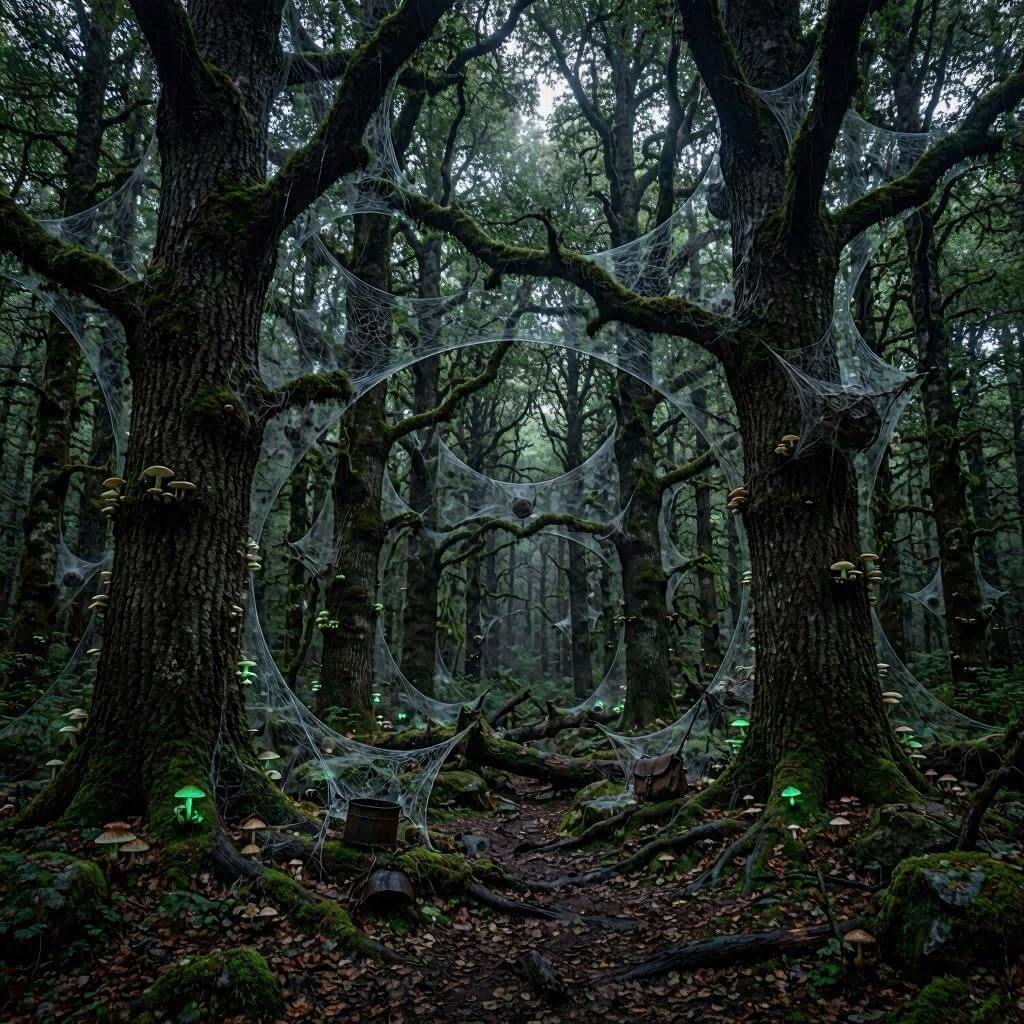
Lost in the Woods
In the previous article, I described a basic ettercap encounter. One in which the players fought the ettercaps.
Ettercaps are also well-suited for an encounter/game in which the players get turned around in a forest and find themselves unable to find their way out. In this article, we’ll discuss how to make that happen.
Know that this is not easy to accomplish in D&D. I’m going to give my best estimate of how this can be done, but I suggest that it only be attempted by an experienced DM—one whose players trust them, and who can judge whether this approach fits their table.
Introduction
When setting up a scenario in D&D—particularly one in which the players are expected to act in a certain way—there are three main steps that must be followed.
- Setting Out on the Wrong Path: Like any step in a hero’s journey, you need to explain how it begins. In this case, you also need to guide the players into getting lost in a way that feels fair. (Forcing players into making a mistake is a terrible idea.)
- Digging in Deeper: For something that takes time, you need intermission scenes to make it feel like time is actually passing. Simply narrating that time passes doesn’t feel convincing. In this case, it can also lead to players later arguing that they wouldn’t have continued wandering aimlessly.
- Resolution: This is how you wrap up the scenario—providing a conclusion that fits and resolves the situation in a way that feels satisfying to everyone.
Now let’s see how to do it.
Part 0: Setting the Scene
(Optional, but highly recommended.)
The players venture into the woods, and you narrate how it becomes increasingly oppressive and eerie. Give them a solid reason to enter, but don’t force them to do so. Having no other idea where to continue the adventure effectively counts as forcing.
Part 1a: Losing the Path
Give the players an encounter that serves as an explanation for why they no longer remember the way back. It shouldn’t be too deadly, as they’ll need their HP, but it must last long enough for their confusion to feel plausible.
(Tip: Real-world time matters more than in-game time. In-game time might make the situation plausible, but it won’t make it feel plausible.)
A simple encounter would be a pit trap, with the ettercaps throwing in a non-intelligent monster to wear the party down. The fact that the players can’t properly protect their mages, and that they’re vulnerable to area effects, is probably enough to make it interesting—but you can add any of the following:
- The monster crashes into the wall of the pit, pinning a PC.
This is usually handled as extra damage, but that’s boring. Instead, treat it as grappled and restrained. As the PC isn’t fully restrained, you can give disadvantage or force concentration checks rather than preventing actions entirely. - As the monster thrashes, the sides of the pit begin to collapse.
If a PC fails a DEX save, they’re knocked prone and must make a STR check to get out. You can also turn this into a time limit, requiring the party to escape before the pit collapses—possibly before defeating the monster. Prepare an outcome in case they fail. - Ettercaps throw stones and branches down into the pit.
Usable during the fight, for extra damage. The players can use their own attacks to maybe force the ettercaps back. Usable also once the players win the fight, since the ettercaps may try to prevent them from climbing out.
Part 1b: The Path Is Lost
When the players climb out of the pit, they no longer remember which way they came from. In addition, webs block all visible paths.
Their confusion might simply be the result of time and disorientation. If so, they have a chance to guess the correct path. If the ettercaps are particularly cunning, they may have dragged vegetation across the true path, hiding the fact that it exists at all. In that case, guessing isn’t really possible.
Either way, you’ll need to account for any abilities the players might have that could help them find their way out. They should also be allowed a skill check to identify the correct path.
If they roll moderately well:
If you’re using confusion as the cause, consider reducing their options by letting them rule some paths out. You can also provide sensory descriptions as they explore—describe sights (a particular flower, for example), smells, and whether the ground is stony or muddy. Then, when they choose a path, give short descriptions of each option. If they payed attention, they now have clues. This will make narrowing down choices feel meaningful.
If you’re using disguised paths, let them know on a successful roll that none of the visible paths look correct. This is a useful clue, even if they don’t immediately understand it. If you want to be generous, include hints such as vegetation moving unnaturally or loose plant matter shifting in the wind.
With any luck, this part will end with them choosing the wrong path.

Part 2: Wandering Into Oblivion
As the players continue, they become more and more lost.
At this point, your job is to continue the story in a way that feels fair. If you jump ahead with narration like “Several hours later…,” you’ll likely get protests that the players would have realized something was wrong. People perceive time based on what happens—simply stating that time has passed doesn’t make it feel like it has.
The encounters here need to be brief. The players can’t rest without being attacked, which means they’re operating with limited HP. (Besides, you probably don’t want this to turn into a retelling of The Odyssey.)
Below are some clear ettercap-themed ideas:
- Webbing blocks the way. Cutting it loose causes:
- Trees that were held apart by the webbing to snap back together, causing the PC who cut it to be tangled up in the webbing.
- Loose strands of webbing to dangle, potentially tangling a PC or catching their weapon.
- The webbing, once loosened, to fall and entangle some of the PCs.
(Use these alongside something that requires a fast response, such as an ettercap attack—see below.)
-
Ettercaps attack.
To keep the game moving, run these as short combats where the ettercaps retreat after a round or two. They’re not trying to finish the fight—they’re trying to weaken the party.This works on its own, but you can add:
- Any of the webbing effects above, making even a 1–2 round fight feel eventful.
- Ettercaps pelting the PCs with branches from above. Provide some form of cover the players must reach, or give them the option to dash toward a clearing where the ettercaps lose their advantage. Be open to creative ways the players might fight back.
- Additional ettercap-themed obstacles:
- A pit or stream the players must cross. Webbing on the far side—or suspended above the middle—makes this more difficult. Adding webbing on the near side gives the obstacle a stronger thematic connection and makes it feel fairer.
- An animal or NPC caught in the ettercaps’ webbing. With a beast, the players must find a way past without provoking it. With an NPC, they may need to decide whether to trust it, especially if it appears threatening.
- The corpse of a dead adventurer, tangled up in webbing. A bag lies nearby containing something valuable, but reaching it is difficult.
(The obstacle doesn’t have to be ettercap-based. The webbing alone establishes the setting, as long as you avoid overly complex setups.)
You can also include “dark forest” style encounters that aren’t directly tied to ettercaps, but use these sparingly or you risk losing the theme. I recommend no more than one short non-ettercap encounter.
Descriptions
The main goal of this entire section is to create the feeling of the players becoming truly lost.
Don’t forget the details of their journey: wandering through the woods, the environment growing more oppressive, light fading as they move deeper into the forest and as night approaches, and so on.
The encounters above exist to give room in which to set up that feeling. Skip the descriptions, and you’ve missed the entire point.
More Ways to Use Forests (and other terrains)
Part 3: Escaping Alive
If you reach the end of this sequence, the players will be low on HP and other resources, and likely feeling stuck and out of ideas. The goal now is to give them a way out that feels satisfying.
(If they feel stuck earlier, give them enough of a chance to escape that they’ll keep trying, and move toward this part as quickly as possible.)
One option is a creepy mansion, or a similar structure. Once they reach it, they’ll be beyond the ettercaps’ ability to pursue. (In fact, the ettercaps should make one final attempt to stop them, if the players have enough HP left to survive it.)
Inside the mansion, include an empty room where the players can take a long rest and recover. Afterward, they discover that the door has disappeared, leaving them with no choice but to continue deeper into the dangerous mansion—but that’s a challenge they can handle.
Altrenate End: River Escape
Another escape option is for the players to assemble an improvised raft and travel downriver. (This is something you can set up in advance, or the players may come up with it themselves if a river is present as an obstacle.)
Possible river encounters:
- Rapids. The players have to avoid falling into the river, or getting their boat smashed (it should have HP). Some of this will be skill checks, but give them a choice of different parts of the river (Shallow water vs. fast moving, choppy vs. a smooth area but with one really hard to avoid rock, etc.) Try to give bonuses and penelties for how they decide to approach the difficulties, and be ready for improvision on their part.
- An attack by flying monsters or creatures on the riverbank with reach. They have to split duties between fighting and rowing. If they have HP to spare, this works nicely in combination with the last, but that’s probably unlikely by this point
Include something in the water that can attack or damage the players as a consequence for falling in.
End
Next, have the river carry them into an underground cave, with no banks to climb onto and a current too strong to row against. This creates an instant “escape the Underdark” style adventure.
(Alternatively, you could send them over a waterfall into a strange valley—but this may feel too similar to the forest escape scenario that came before it.)
Afterword:
This encounter is meant as a nasty predicament. It will hopefully set a tone that not every situation is survivable, and that they’d better be careful where they go and what they do, along with creating a memorable encounter that will lead the story on. What I did not do is create a main story in which the players truimph despite being over their heads. If you’d like a look at how that could be done, check out my article on the Shadow Dragon

Leave a Reply