Combat rating 3
1 Ettercap (CR 2)
2 Needle blights (CR 1/4)
1 Vine blight (CR 1/2)
Combat rating 3
1 Ettercap (CR 2)
2 Giant wolf spiders (CR 1)
1 Harpy (CR 1)
Combat rating 4
2 Ettercaps (CR 2)
1 Wererat (CR 2)
Combat rating 5
2 Ettercaps (CR 2)
2 Ghouls (CR 1)
1 Vampire familiar (CR 3)
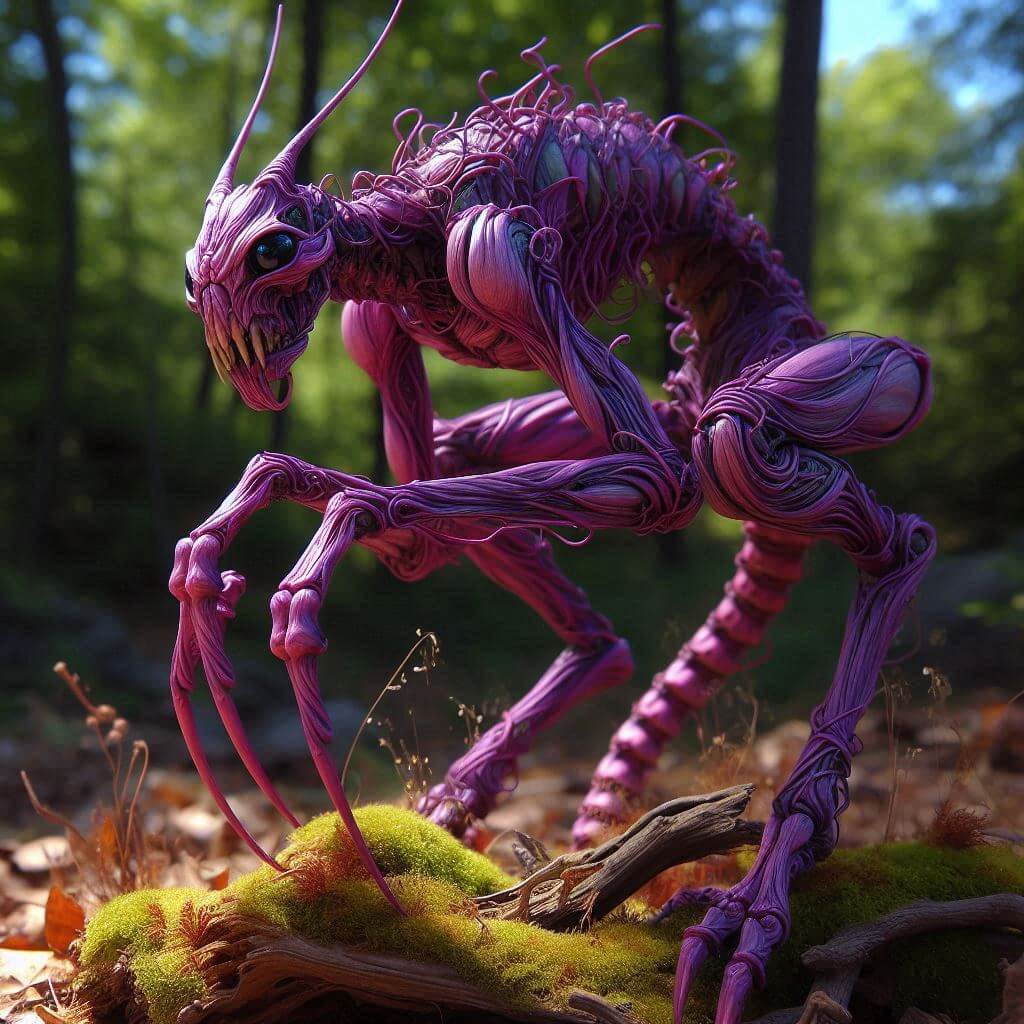
Ettercaps are monsters that look like a cross between a human and a giant purple bug, and act like giant spiders. They live in large colonies of their own type, which immediately makes them a tricky monster to run in D&D encounters. How do you send the players against dozens or more of the same monster?
While using them as minions is always an option, how can we make them work on their own?
(This article will give ideas that can apply to many cases of using minions, as well as teaching how to run your own large-scale battles with a single monster type.)
How to Use a Pack of Monsters
The first thing we need is a reason for the players to fight the ettercaps. Saying that they’re trying to get rid of them is a pain, because it forces the players to fight each one, and that drags on.
What else can we do?
- The players need a magical item (MacGuffin). You can say that the villain hid it in the ettercaps’ area to keep it safe, or that the ettercaps stole it.
In a variant, the party may need access to the ettercaps’ territory because there’s a magical location required for a spell or ritual, or simply because they must pass through the ettercap-infested woods to reach a specific destination. - The players chase a target into the ettercaps’ territory. This could be a person with an item or a magical creature.
You could have the ettercaps grab it before the party has a chance to—but you don’t need to. The ettercaps can grab the players instead, as I’ll explain below. - If the goal is to eliminate the ettercaps, give them a “head” ettercap whose defeat will break the rest.
Give this leader maximum HP and +2 to hit, damage, and saving throws, and you have a solid boss for a monster tactics encounter.
Of course, you’ll still need a reason why the party needs the ettercaps defeated that fits your campaign.
Combat Encounter 1: Large-Scale Combat Encounters (difficulty 5)
I’m going to divide this encounter into three parts.
Part 1: Win conditions for a large group of enemies.
Part 2: Two ways to run a large-scale battle.
Part 3: Making ettercap combat fun—tricks and traps.
Let’s get started.
Part 1: Win Conditions
As the players enter the forest, they are attacked by a group of ettercaps. The first question we want to ask is: how do they win?
Many people answer this by requiring the players to take down all the monsters. I find this slow and boring, even in a scenario with many different monster types—let alone in a situation like this. (Another negative is that it forces you to reduce the number of enemies to a manageable amount, which makes your villain’s power far less impressive if anyone stops to think about it.)
Here are other possible win conditions for this kind of D&D encounter:
Kill the King
A classic victory condition. It assumes that taking out the leader will end the fight. I suggest having this cause the others to panic and scatter.
To make this work in a single fight (i.e., without making the players fight through a dungeon to reach him), you have to both strengthen and weaken him.
Strengthen him by making certain that he has enough HP, and by keeping him where the players can reach him—but not easily, and not all at once. If you don’t do this, he’ll quickly become the target of every attack, and your combat will collapse. What this needs is a moving battle, where the situation can change in the middle. As it happens, that’s already the plan for this ettercap battle.
Weaken him by making sure that he enters the fight as needed. Be open to adjusting the battle if the players are having too much trouble, and give them ways to reach him. This can be done by having him grow overconfident, or by having his minions begin to panic, forcing him to join the fight in order to stop them from fleeing.
Kill a Certain Number
The idea here is that the enemies will break and run once enough of them are defeated.
Let the players know this beforehand, either through an NPC or through character knowledge. Then narrate two or three moments of the enemies beginning to worry before they finally break, so the players understand that they’re making progress.
I suggest the following steps:
- The enemies shy back for a moment before a command from a boss forces them to attack again. Make sure the players notice that moment of fear.
- The lesser ettercaps shriek and scatter. The leader joins the fight personally to rally them.
- They begin fighting with desperation born of panic. This can increase difficulty, if you judge that the players can handle it. Again, make sure the players understand that this is a positive development.
- They break and run. Victory!
As mentioned above, you don’t necessarily need all four steps. I suggest skipping either step two or step three.
In order for the number of enemies defeated to feel significant, you’ll want to include a mix of very weak and slightly stronger enemies. Scatter a number of enemies with extremely low HP, damage, and overall effectiveness, while also placing a few more powerful enemies among them so that area spells don’t simply wipe everything out.
Either set minimal HP and damage by your best judgment, or use very weak stat blocks (approx 10% CR of the main enemies. for ettercaps, this means CR 1/8 or CR 0) and adjust the description to fit. The stronger enemies should still be limited—CR equal to the players’ level at most, and half that is also fine. (i.e., this encounter works well for players of level 4–5.)
Escape the Area
The players must fight their way through a number of enemies in order to escape. Killing enemies helps, but it is not the primary goal. This works particularly well with ettercaps.
Ettercaps have a special attack that allows them to grapple a PC and pull them upward. This gets the players off the forest floor and into the treetops, where the ettercaps are at their most dangerous and most interesting.
It also prevents the players from simply dashing away at the start of the battle—they first have to rescue their ally.
Once they reach the treetops, their movement options become more limited, and you can position one or two ettercaps directly in their path.
After they break free the first time, you’ll want to set up approximately two more locations where ettercaps block their way again.
Set up reinforcements to arrive primarily at these locations. This creates something closer to a series of connected battles, while still letting you control positioning so the players must push through enemies instead of turning the encounter into a chase.
Occasional reinforcements will still be necessary. Otherwise, the players will try to clear each location completely before moving on. They’ll probably attempt this at the first location anyway, so you’ll need to emphasize that reinforcements will continue arriving—and factor in the damage taken and resources spent in earlier fights when judging how much they can handle.
Time Limit
This is a strong fourth option for a large-scale battle.
Unfortunatly, it doesn’t fit ettercaps well.
What a time-limit encounter needs is an enemy that can improvise, shift the battlefield, prevent the players from finding an optimal defensive position, and keep the fight dynamic. Ettercaps aren’t intelligent enough for that. Perhaps I’ll discuss this idea when covering a different monster, someday.
Part 2: Pace of Reinforcements
How should you handle reinforcements arriving during a large-scale D&D combat?
I’m going to give two methods.
Stream of Reinforcments
The first is the classic approach: add a number of enemies every round. If you do this, I strongly suggest not adding them at a fixed rate, and not every round.
There are two reasons for this:
- It makes the battle feel rote and predictable—like a game mechanic rather than something real.
- Balancing encounters is already tricky, and reinforcement-based encounters are even harder. You need to keep reinforcements uneven so you can adjust their arrival rate as needed, without it being obvious that you’re doing so.
Adding enemies in small groups is also a good idea. A single enemy at a time doesn’t feel significant, and even if they eventually add up to something major (instead of being killed before that can happen), having your battles feel impactful is a major plus.
Taking Turns Fighting
The other method is to have a large number of ettercaps present, but not use all of them at once.
Ettercaps aren’t highly intelligent and behave more like animals, so it’s reasonable that some would be actively fighting while others hang back, watching and deciding whether it’s worth getting involved.
You’ll want to start with a large number—roughly as many as you would use if all of them were participating at once. As the players begin to gain the upper hand, ettercaps can use their climb speed to retreat, temporarily leaving the battle as a kind of victory reward for the players.
When you want to bring more into the fight, frame it as the ettercaps taking advantage of the players’ exposed backs, or reacting as the players move closer to their objective.
When reintroducing ettercaps, prioritize those that are already injured—not exclusively, but mostly. While it may seem illogical for injured ettercaps to rejoin the fight, it’s important for player perception. The players need to feel that their actions are having an effect on the battlefield.
You can justify this by saying that injured ettercaps are trying to prove themselves to the others.
And above all, keep the focus on the goal, not just the battle itself. If the goal involves a villain, make sure they remain active and visible. If not, reference the objective throughout your descriptions and build a sense of urgency.
Either way, have the ettercaps react primarily to the players’ position relative to the goal, rather than to anything else.
I’ve used the first way in scenarios where the players are also working to accomplish something specific, such as a chase through passages, but for battles when the battle is the entire goal, this might be more interesting and capture the feel better. In other words, I’d use it for Kill the Leader and Kill a Number goals, and use the first for Reach an Objective and Survive for a Time goals, to let the players know that their time is limited. That said, either method can work with any goal.
More Skirmisher Battle Tactics

Part 3: Ettercap Traps
Ettercaps are fond of traps (Monster Manual), so let’s look at how they can—and will—take advantage of the players.
As an aside, keeping afight moving is often very useful in a D&D encounter. There are several reasons.
- It lets you place traps and obstacles in the players way.
- Different terrain, even simply different arrangments of the same terrain elements (walls, trees, brush, etc.) can add a lot of variation to the fight.
With some enemies, the way to keep a fight moving is to use distance attacks or to make the terrain dangerous. (For example, a fire forces the players to keep moving to outrun it.) With the ettercap, you’ll do it with their web strand reel. If using Kill the King as an objective (see part 1 above), you can also do it via moving target. (another classic that works with most enemies.)
Let’s move on to having to discussing ettercap tactics in particular.
Battle of the Treetops
A strong way to begin the fight is with the ettercaps snaring one of the PCs and pulling them up onto a tree branch, forcing the rest of the party to give chase if they don’t want to lose their comrade.
Which PC they choose to snare is uncertain. Ettercaps have enough Wisdom to notice which characters are muscular and/or wearing armor, but probably not enough to identify classes. They also won’t necessarily choose the smallest target, as that means less flesh to eat.
Either choose at random, or select someone with high Dexterity, as they are the most likely to survive and escape. You can justify this by treating a high-DEX character as the best compromise between too strong and too scrawny.
Ettercaps have low intelligence, but not no intelligence. Their traps are essentially different uses of their webbing. You generally can’t get away with telling players they “didn’t notice” something, no matter how difficult it would realistically be to detect.
I suggest using these traps as active combat elements that players must deal with once triggered, rather than as hidden traps to be searched for. Constant movement and action are key in a D&D combat encounter, and having players carefully probe every step is a quick way to kill the pacing.
Ettercap Webbing Traps
- Webbing blocking the way: When the players cut through it, the branch they are standing on gives way. The webbing was actually supporting it.
- Tripwire: A classic and effective option, easily done with webbing. Trips the player, causing him to fall prone and possibly fall off the branch into webbing spread below. Works best after the players have already cut through other webs.
- Rising webs: An ettercap jumps between branches. Immediately afterward, a different ettercap raises (or lowers) a set of branches, with webbing stretched between them.
Play fair by letting the players see ettercaps jumping onto a branch and being raised by another. - Rustling leaves mark passage: The ettercap being chased seems to vanish, and rustling leaves provide a false trail. In reality, the leaves are being pulled by a strand of web, while the ettercap climbed up or dropped down.
- Ettercap ducks beneath: The ettercap moves on all fours instead of walking upright, allowing it to slip beneath webbing hidden behind leaves.
Narrate this naturally—either by having it run on all fours for a stretch, or shift to all fours after a jump between branches. Include other movement details so this behavior doesn’t immediately stand out as suspicious.
Not Quite Traps, But Still Dangerous
- Falling webbing: Webbing can be dropped onto PCs by cutting it loose from the branches above. Treat it like a net, but with a higher chance of restraining the target.
- Fighting among the branches: With webbing everywhere, it becomes easy to knock PCs off branches and into waiting webs. This can be done with push or trip attacks, by cutting away the branch beneath them, or with a web garrote.
(Don’t overuse this. Once or twice is interesting; constant use becomes a nuisance.)
More forest encounters (as well as ideas for other terrains)
Summary: Six Ideas for Running a Large Number of Foes
- Some enemies are known to live in large numbers. This doesn’t mean you should run many small encounters. There are better ways to handle a crowd of foes, such as sneaking in and holding off the numbers while killing the leader.
- When an enemy has vast numbers, the goal shouldn’t be to kill them all. One effective approach is to have the fight take place along narrow paths, limiting how many enemies can engage at once. The players win by reaching and destroying something—magical or otherwise important.
- When fighting a large number of foes, the goal should be an objective, not killing them all. Also, keep the battle moving—don’t let the players hole up. Waiting for reinforcements can work, but not if the players fortify and wait. If they try, force them out.
- When enemies have numbers, some DMs send in steady reinforcements every turn or two. Don’t. Being unpredictable is both more exciting and makes it easier to adjust as needed. Even the best DM can’t predict everything, so leave yourself room to adapt.
- When enemies have numbers, you don’t have to send them all in at once. A small group might believe themselves sufficient, while the rest watch. After they see how strong the players are, they may hesitate to join. You still need a clear reason why the players win.
- When there are many enemies, the sensible approach is to keep injured ones safe. This isn’t always the right choice. As DM, your goal is player enjoyment, and not getting kills can be frustrating. Say that injured enemies have more to prove, and send them back into the front of the fight.

Leave a Reply